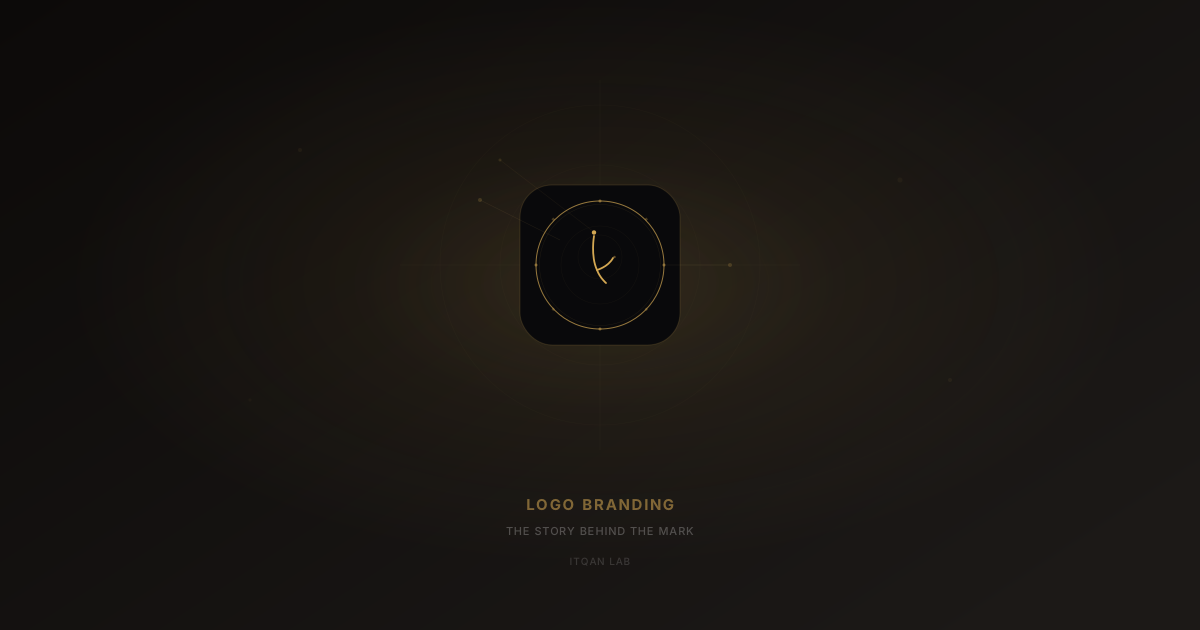
Most logos are designed to look good. Ours was designed to mean something.
When we set out to create the ItqanLab brand mark, we didn’t start with shapes on a screen. We started with a word, a language, and a philosophy that’s been shaping craftsmanship for centuries.
Starting with Meaning, Not Aesthetics
“Itqan” (إتقان) is an Arabic word that carries weight. It means mastery — the kind where every detail is considered, every decision is deliberate, and the final result reflects deep care. It’s not a casual word. In Islamic tradition, it describes the highest standard of workmanship.
The logo needed to carry that meaning visually. Not through literal illustration, but through the feeling of precision itself.
The Calligraphic Root
Arabic calligraphy is one of the oldest and most sophisticated visual systems in the world. Every letter has rules — stroke order, proportional relationships, connection logic — that have been refined over a thousand years.
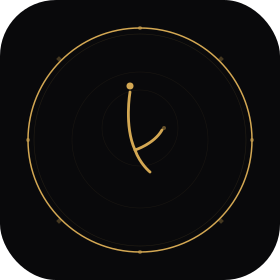
We drew from this tradition directly. The central mark in the ItqanLab logo is a stylized calligraphic gesture: a single flowing stroke that curves from top to bottom, branches outward, and terminates with controlled precision. It’s not a specific Arabic letter — it’s the essence of Arabic letterforms distilled into a symbol.
Why Calligraphy and Not a Wordmark?
A wordmark would have been the safe choice. But we wanted something that works across contexts:
- At small sizes — favicons, app icons, social avatars
- Without text — the mark should be recognizable on its own
- Across cultures — the calligraphic gesture reads as elegant and intentional, even to audiences unfamiliar with Arabic script
Anatomy of the Mark
The logo is built on a system of deliberate geometric relationships:
The Container
A rounded square with a 56px corner radius on a 280px canvas. This shape sits between a circle (organic, approachable) and a square (structured, technical). The radius was chosen to feel modern without being soft — precision, not playfulness.
The Ring System
An outer circle inscribed within the container creates the boundary. A thinner inner guide ring establishes the proportional space where the calligraphic mark lives. Four cardinal dots sit at the compass points of the outer ring — north, south, east, west — grounding the composition and adding the subtle suggestion of a compass or navigational instrument.
Four diamond accents at the diagonal corners (45-degree points) complete the geometric framework. These are barely visible at first glance but add a layer of detail that rewards close inspection.
The Central Stroke
The calligraphic mark itself consists of three elements:
- The main stroke — a sweeping curve that flows from the upper left downward and to the right, mimicking the natural motion of a calligrapher’s pen
- The branch stroke — departing from the main curve and extending outward, creating tension and direction
- The dots — a primary dot above the stroke (bold, definitive) and a secondary dot at the branch terminus (subtle, fading) — echoing the dot system fundamental to Arabic script
The strokes use rounded caps (stroke-linecap: round) rather than flat ends. This is a direct reference to the nib of a traditional reed pen (qalam), the primary tool of Arabic calligraphy.
The Color Decision
Amber, Not Blue
Technology companies default to blue. It signals trust and reliability — and it says nothing. We chose amber (#d4a853) for the mark, a color that carries its own set of associations:
- Historical resonance — amber and gold have been the colors of Arabic manuscripts, mosque decorations, and calligraphic art for centuries
- Warmth and confidence — amber communicates authority without coldness
- Distinction — in a sea of blue tech logos, amber is immediately recognizable
The Dark Ground
The mark sits on a near-black background (#09090B) — not pure black, but a tone with just enough warmth to feel intentional. This creates a contrast ratio that makes the amber elements luminous without being harsh.
Opacity as a Design Tool
Not every element in the logo is at full opacity. The cardinal dots sit at 50%, the diagonal accents at 30%, the inner guide ring at 8%. This creates depth hierarchy — a foreground, middle ground, and background within a single mark. It’s a technique borrowed directly from traditional calligraphic compositions, where secondary strokes and decorative elements are rendered lighter than the primary text.
Construction Grid and Proportions
Every element in the logo is positioned on a mathematical grid:
- The container is 280 x 280 with 56px corner radius (exactly 20% of the width)
- The outer ring has a 112px radius (80% of the half-width)
- The inner guide ring has a 68px radius (approximately the golden ratio relationship to the outer ring)
- The calligraphic mark is centered at (140, 136) — slightly above true center, because optical center sits higher than mathematical center
- Stroke width is 2.8px — proportional to the container size while maintaining legibility at small scales
These aren’t arbitrary numbers. Each proportion was tested at multiple sizes to ensure the mark reads clearly from a 16x16 favicon to a billboard.
Typography Pairing
The logo mark doesn’t exist in isolation. It’s paired with a typographic system:
- Outfit — a geometric sans-serif for the “ITQAN LAB” wordmark and headings. Its clean geometry complements the structured elements of the logo while its subtle personality prevents it from feeling generic.
- IBM Plex Sans Arabic — specifically chosen for Arabic text. Not an afterthought — a typeface designed for Arabic on screens, with proportions that harmonize with Outfit’s Latin characters.
The wordmark uses 0.1em letter-spacing in uppercase — wide enough to feel premium, tight enough to read as a single unit.

How It Scales
A logo that only works at one size is a failed logo. The ItqanLab mark was tested across:
- Favicon (16x16, 32x32) — at this size, only the central calligraphic stroke and primary dot are visible. The rings and accents disappear, but the mark remains identifiable.
- Social avatar (80-120px) — the ring system becomes visible, adding context and structure.
- Website header (40-60px height) — paired with the wordmark, the full brand expression is present.
- Print and large format — at large sizes, every detail becomes visible: the secondary dot, the diagonal accents, the subtle inner ring. The logo rewards inspection.
What We Learned
1. Cultural Roots Aren’t Decoration
Drawing from Arabic calligraphy wasn’t a stylistic choice — it was a structural one. The proportional systems, stroke logic, and compositional rules of calligraphy gave us a design framework that’s both beautiful and rigorous.
2. Restraint Is the Hardest Part
The final logo has fewer elements than our early explorations. Every iteration was about removing what wasn’t essential — a calligraphic principle itself. The best version is the one where nothing else can be taken away.
3. Details at Every Scale
The opacity layers, the cardinal dots, the diagonal accents — most people will never notice these individually. But they’ll feel the difference. A logo with depth reads differently than a logo with just a shape.
4. A Mark Should Carry Philosophy
The ItqanLab logo isn’t just a visual identifier. It’s a compressed expression of what we believe: that craft matters, that Arabic design traditions are a source of innovation (not just heritage), and that precision and beauty are the same thing.
This is the kind of intentional brand work we do for our clients. If you need a brand identity that means something — not just looks good — let’s talk.
Related: Read about Why Your Startup’s Brand Identity Isn’t Just a Logo, see the full ItqanLab project case study, or learn about our Brand Identity services.